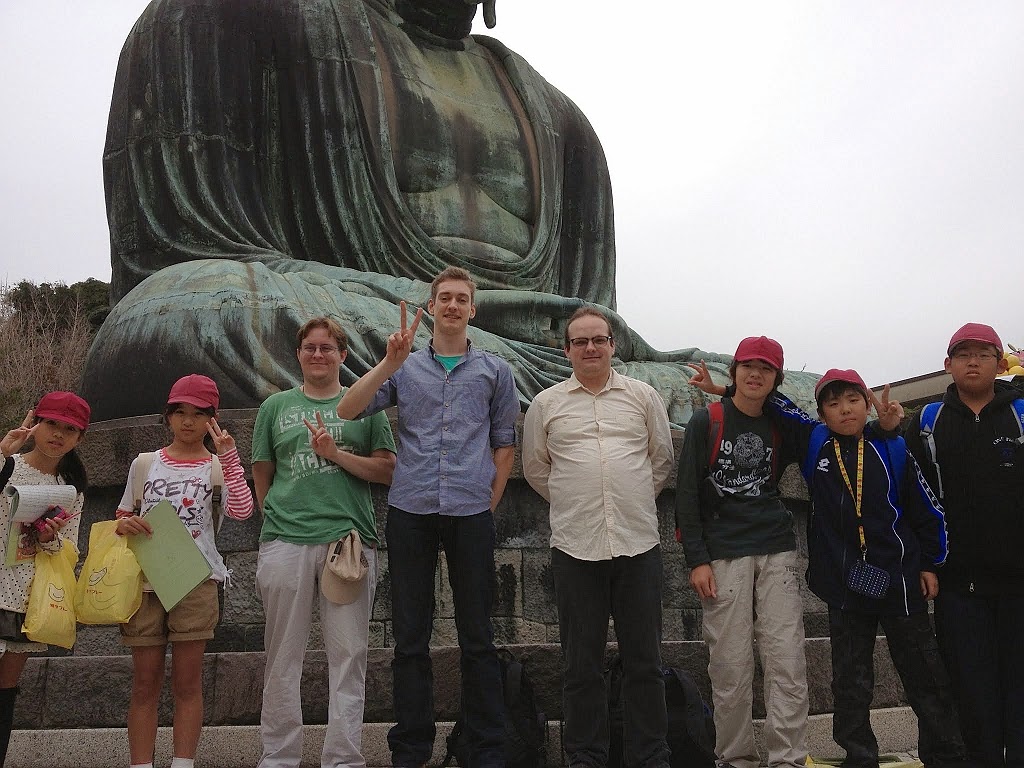
Day 12: Nara
- Date: October 24
- Weather: Sunny and nice
- Mood: Not that excited, but let’s do this anyway
The deer song - Going to Nara!
Postponed for one day, but we’re going to Nara either way. Today was sunny, so no more reason to postpone this trip.
We got up early and got ready to leave. I shave myself for the last time on this trip (once per 4 days. Too frequent for my taste, but it's needed). While Steven is opposed to it at first, we end up having the breakfast in the Zen Cafe again (it’s time-saving and it’s a good meeting place in general).
Colette met us at the Zen cafe and while we were preparing to head out, we checked the menu for once to see if we could have a drink here tonight. We noticed that the cafe has Belgian beers. We mentioned to Colette that she should try out Duvel (considering most beers are 500 yen in cafés, the 790 yen for the Duvel is quite an acceptable price) and we make plans to go to this cafe this evening.
After this intermezzo, we walked to the station to get a train to Nara.
When arriving, we noticed that the town has a lot of connections with deer. Steven mentioned that deer run around in the wild here (he really wanted to take a picture with one).


Leaving Kyoto Tower for one day to be welcomed by... a deer man?
One of the famous tourist spots is the big Buddha of Nara (the biggest of Japan). To get to this, we walk through a shopping street and notice a game hall which has Kiss Kiss Bang Bang (you know, the game I mentioned from Akihabara). We couldn't help showing it off to Colette and she found it quite amusing as well.

At the end of the street we spotted a pond with turtles and we couldn't help finding it cute and took pictures of it (*hums the eighties TMNT song*)


Next to the pond, we climbed up some stairs and arrived at the site of the 5-store pagoda. We avoided the Labatory sign (is it a laboratory-lavatory? Do they experiment on people taking a shit?) and walked to the pagoda itself.


We encountered a random guide that explained the history of the pagoda. And we almost burst into laughter as for the tenth time (or so)on our trip we heard about a big, monumental building being burned down several times and being rebuilt (trust me, this is a thing EVERY Japanese historical building has in common). At least the guide told us that after the fourth or fifth time being burned down, they figured out they needed a lightning rod.


When getting closer to the pagoda, we encountered our first few deers. They’re quite used to humans and are easy to take pictures of. While walking the path towards the great Buddha, we encountered a park for the deer that are running around freely.
They do include warning signs saying that they remain wild animals (they can obviously react unpredictable). I couldn't help smiling as an old man selling deer cookies had to chase some deer away, to stop them from eating the cookies (oh, the irony).


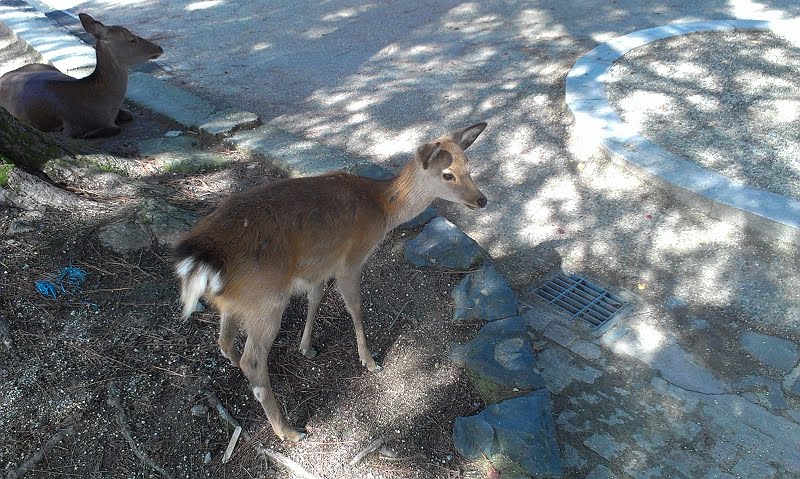
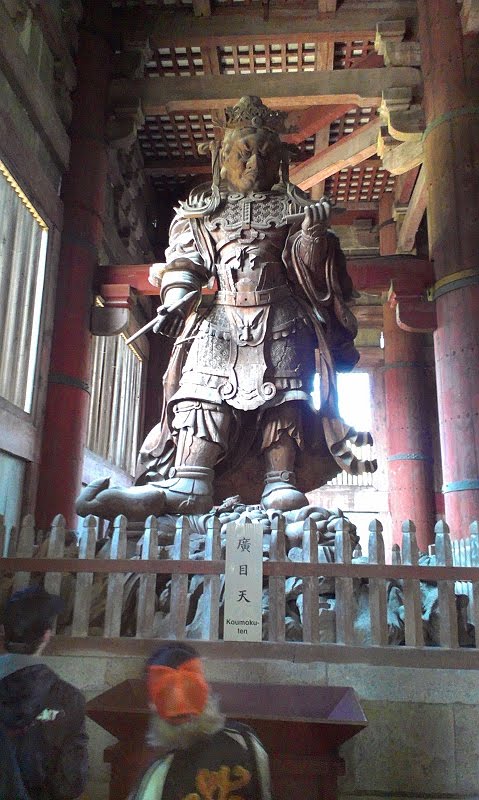
After a nice long walk (and a bought ice-cream), we got on the path to the great Buddha, with more deer everywhere. We also started noticing trails of deer piss and poop, forcing us to look down so that we didn't step in some deer shit. We passed the gate guardians (Agyo & Ungyo) and payed our entry ticket for the great Buddha.


We encountered a creepy Buddha in a poncho (why?) and entered the temple to meet the big guy. Here, we were allowed to take pictures (for once), so picture time!




Haiku-man and the Man-flu
We noticed Steven was getting sicker(the man-flue, as Colette jokingly called it), so instead of going to the next stop (a palace whose name I've forgotten), we accompanied him to the station to see him off.
On the way to a station, we encountered a rambling old man (who knew his English pretty well), trying to get famous with haiku’s (guess what? It isn't working) and it took him at least 15 minutes to just beg for some money to support him. After his intentions were finally clear, we gave him some money and got rid of him.
We said our goodbyes to Steven who returned to Kyoto. And then Colette, Francis and me found something to eat in a local restaurant. I took a cheap beef bowl (time to look at the money, since I can’t get any from the darn’ ATM’s).

The failed trip to Heijo Palace
After lunch, we tried to find the Heijo palace, but (once again) the tourist map was quite misleading (I really, really hate Japanese tourist maps!). This map fucked up the distance scale. According to the map the walk to Heijo palace should be just as short as the walk to the great Buddha. But in reality, it's two to three times that distance.
We only noticed the flaw of the map when we finally encountered the station that was about halfway the route... after walking for over an hour. The map also pointed that this was the closest (local) train station. Also there were no signs of buses anywhere (not on the map, not in the street). We discussed about it for a while, but decided to go back to the station and enjoy the walk instead.
Somewhere along the path, we encountered the "Knob" café, making Colette giggle and take pictures of it (we didn't get the joke at first, but err... just look it up on the urban dictionary).
We took the train back to Kyoto and got something to drink at the Zen cafe instead. Colette tried the Duvel, while we tried Takoyaki and other Belgian beers. After resting for a while, Steven joined up with us and had a drink as well (yeah, man-flu doesn't last THAT long).


Omnomnom... Takoyaki :-P .
We split up with Colette, because we had reserved an initiation lesson. We agreed to go to her hotel afterwards. She mentions that there’s another guy from Ghent staying at her hotel, so she wanted us to meet him (as we are from the Ghent area).
Thus we went to our initiation lessons. Steven had an Origami lesson with a few other (Dutch) people, while Francis and I had a Go initiation. It’s been since watching/reading Hikaru no Go that I had seen anything about the game. But our sensei gave us clear instructions (even with limited English Vocabulary) and it came back quite quickly. It remains an interesting, strategic game.
After the lessons, we prepared once more to go out and walked to Colette’s place. Here we met with the other Belgian guy. This guy’s named Daan and he apparently is a journalist, working freelance for "De Tijd", a famous economic paper in Belgium. He was doing a series of articles on business and working in Japan. He also stated that Kanazawa (the place we stayed before Kyoto) and Ghent are sister-cities. We were surprised to hear this.
Colette wanted to take us to a restaurant where they serve a local specialty, Yakitorii (basically: chicken meat sticks). We say goodbye to Daan (he already had dinner, so he didn't feel like joining us).
We entered the restaurant and tried some of the Yakitori. It comes in all tastes and flavors (with veggies, with cheese, with soy sauce, etc.) and comes from all edible part of the chicken. We had quite a few of them and tried out different combinations, while drinking some beer/sake with it.

Delicious. Chicken breast with a cheese sauce.
Afterwards, we split up with Colette and walked back to K’s house; off to bed.
Tips for traveling in Japan - Electricity and cellphones
One of the thing that people forget about easily is that Japan has different electricity sockets (unless you live in the states).
Yes, the power sockets are similar to those in the States, safe that you'll only find them in the 2-pin variants (without grounding pin).

These kind of 2-pin plugs
I personally thought I had the right adapter, but the damn thing had a grounding pin and hardly fitted anywhere (the sockets in most hotels/hostels have NO space for the grounding pin). My adapter could only fit in single-socket extension cords).
And in this digital day and age, you'll need at least 1 adapter per person in your group. We had one-and-a-half for our group (half if you include my three-pin adapter) and often had to discuss what device we wanted to charge first.
And on cellphones? Well, pre-paid cards will probably not work. Regular contract cards will work, IF your contract and your phone support 3G and above. So if you still have an old phone, it may be time to switch to the smartphone generation of phones.
I personally had to buy a newer phone (HTC One V) and switch to a newer type of contract to ensure I could call or send messages in Japan. My previous phone was a Sony W300. And while that phone still works very well, it does not support 3G.
If you're not certain about your phone working in Japan or your contract allowing 3G, better contact your provider BEFORE you leave.
Alternatively, you can always buy a phone in Japan, with a prepaid card. But it will cost you a lot. I heard that Japanese prepaid cards will not work on foreign phones (curses) and Japanese phone companies tend to overcharge tourists when selling them phones/cards.