Day 8: Exploring Takayama and the trip to Kanazawa
- Date: October 20
- Weather: Nice & sunny
- Mood: Re-energized
Wake up! Wake up! Wake up!
That morning, we woke up in the strangest of ways. Last evening, we set the alarm on Francis' iPhone so that we could wake up at 8 A.M. We also plugged the phone into an electricity socket. But when the alarm on Francis' iPhone went off at the set time, the television activated as well at the same time!
We awoke immediately and were quite freaked out at the occurrence, as we had no idea the TV had an alarm, let alone anyone setting the alarm. We fizzled around with the TV for a bit and turn it off.
I shaved my beard off again, while Francis returned to a half-asleep status and Steven went for another hot bath. When we were all ready/fully awake, we walked to the breakfast hall for breakfast.
Once again, we got quite a big breakfast. Bacon and eggs, Bread of various kinds, yogurt, fruit juice, coffee, etc. Steven had quite a variety of Japanese shizzle you sometimes didn't want to know what it was. He tried the natto beans for the third time and now finally gave up. I don’t care if it’s healthy, it’s so not worth eating it.

After breakfast, we packed up, left our stuff in the care of the owner of the hotel and walked to the station. Once there, we go to the tourist information spot and pick up a tourist map. We read the map and start exploring Takayama itself.
Exploring Takayama Pt. 1 - Market area and the festivity museum
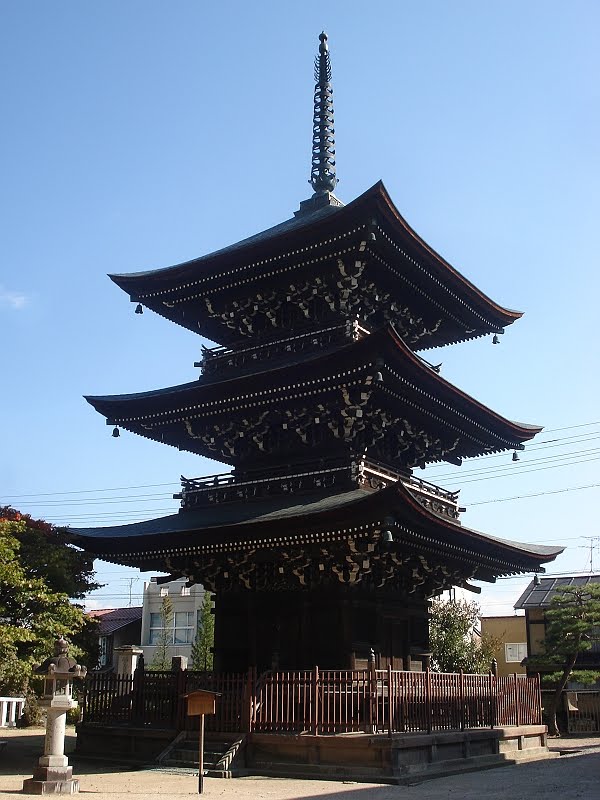
We visited a small pagoda close by the hotel and then walked through a crowded morning market (one of the two or three in Takayama) next to the mountain river.
After seeing most of the market, we walked down some stairs and took a walk next to the mountain river. We noticed it was so clear you could see all the fishes swim.
A bit further, we walked towards the festivity museum. We didn't enter it, as the price was a bit expensive and we weren't that interested. But there were some nice things on the outside of the museum, so we explored the outside area a little.


Come over here, kid. Wash your hands with me. I won't bite. Muhahahaaaa....
At the festivity museum site, we went to a shrine on top of several stairs, which held the Kyoujin-isi (the madman stone). It said to turn anyone who touched the stone into madmen. I dared to touch it, but I’m still okay (at least I think so...).

At the same site, there was a fortune-telling machine (I wonder if Francis took a picture of it?) and Steven had to try his luck again after the bad fortune he got at the Senso-Ji (real credibility, mr. "I-don't-believe-in-fortunes"). The machine itself looked like an old fairground machine from the 70's or earlier; quite mechanical.
Steven entered a 100-yen coin. The fortune machine had some animation and threw him a "sealed" slip of paper. Steven opened it, but we could not understand a word of it, as there was no English explanation.
Exploring Takayama Pt. 2 - The walking course & Walking Path of Literature
After looking at the tourist map for a while, we decided to follow a walking course that passed by the highest point of Takayama and went past the "old house district". So off we went. The walking course itself was quite nice. The mountain area was quiet and felt like your typical mountain villages. Quite different from the busy city center, where the old house district was.


At one of the local shops close to the old house district, we bought a dango stick. It was not sweet, but dough-like and quiet good in terms of taste (70 yen? That’s cheap! Buy one!). We also spotted a vending machine with juice cans of Dragonball Z and Kamen Rider (lol). I bought a DBZ can, which had a Chao-Su-theme. After drinking from the Chao-Su can, I realized it was basically fanta.
After seeing the most interesting spots of the city center, we walked to the other side of the town because we wanted to see the Hida Folk Museum. On our walk there we passed by a random shop that had steel constructions, including an Alien-like chair. Quite funny, if you ask me.


After quite a walk, we ended up at the other side of the city. We spotted a few shops and entered the local shoe and clothing store to try out some of the local stuff (and use the sanitary environment to say it in a clean way).
We noticed that Japanese size of clothes are smaller than the European ones and that basically nothing fitted Steven (who is a giant when compared to the average Japanese person). After a few laughs, we head further to the folk area. We walked the “Walking Path of Literature” (nice views and some random rocks with Japanese poems carved in them) and ended up in a local restaurant, where we had lunch. I had Katsu kare (curry with deep-fried pork cutlet)! As I said before, I love that curry!


Exploring Takayama Pt. 3 - The 7 gods of fortune
After lunch, we walked into the wrong direction (again) and encountered a weird temple in the distance that wasn't drawn on the tourist map (Tourist maps don’t have all the roads printed on them? That kind of sucks). Only back at home (after a bit of researching) I found out that it's the Sukyo Mahikari Headquarters (Google maps, Google translate and Wikipedia did help me out).

We noticed where we went wrong, traced back our steps, found the right road and walked to the Hida Folk Village. But before entering there, we visited the place called the 7 gods of fortune (because we don't believe in good/bad fortunes, right?).
If you fancy giant wood carvings of ancient gods, this is your place. I personally thought it was just a big rip-off (500 yen entrance for 7 statues and nothing more… I was kind of underwhelmed). The entrance even had a note from the Guinness World Record book that they weren't selected for the book, because there are bigger wood carvings in South America (oh well, at least they tried?).

Seven goofy statues like these, were they laughing at us?
Hida Folk Village
After this short intermission, we went to the long-awaited Hida Folk Village. We entered and explored the place thoroughly.
It’s quite a nice place for the culture and history-minded. And while Steven and Francis were not so impressed by it all, I found it an interesting sight. Though I had to agree to what Steven said: We have the same thing in Belgium, but in Western style. It’s called Bokrijk and just like this one: It's nice, but it’s not THAT impressive.


After the village experience, Steven decided to randomly walk some street to get back to the station. Not surprisingly, we kind of got lost, since a lot of the streets we took were not really on the tourist map (did I mention that tourist maps suck? Because they do!). After checking on Google Maps at home, I realized the route we took, took us further away from the station instead (*facepalm*).
After and adventurous walk (I’m still surprised how we didn’t get hit by any car) and asking for directions a few times, we finally got back to the station. We got our stuff at the hotel and took the train to Kanazawa.
The awkward trip to Kanazawa
Due to our long walk in Takayama, we arrived in Kanazawa a little late (around 8 PM). Because of this late hour, the tourist information spot was closed (curses), so we couldn't really ask for directions or get tourist maps.
And even though we had printed out directions to the guesthouse we wanted to stay the night (Guesthouse Ochakare), we were kind of tired and didn't want to search for it in the dark. So we decided to take a taxi to the guesthouse we were going to stay.
Weirdly enough the taxi driver never heard of the place (admittingly, this guesthouse was still quite new). Even after giving him the Google maps printout and the address I got from the net, he still couldn't find it (awkward). After driving for five minutes or so, he turns off the counter and drives us to the taxi central, while apologizing to us (we were jokingly telling each other he would drive us into a dark alley and meet with the Yakuza).
At the taxi central, the driver took the google maps directions with him to his boss and came back 5 minutes later with GPS coordinates. And even then, it still took him 10 minutes or so to finally find the Guesthouse (WITH our help). That was probably the most awkward ride I had ever.
Though I have to mention (in the taxi driver's defense) that being a taxi driver or mailman in Japan must really suck. That's because not a single house has a number on it (it has the family name instead) and while the streets have a name, they’re hardly mentioned anywhere. Good luck finding a random house if you don’t have a GPS or google maps with you.
So, we checked into the Guesthouse and were quite surprised by the small size of the building. Although, the building was literally as it said: a guesthouse; a house that was modified to fit multiple guests. But while the house was just the same size as most city houses, it was modified so it could house 10 guests or so, plus the hosts.
As you can probably guess, the rooms were small… incredibly small. The three of us had a room right next to the living room… in a closet.

Smallest! Room! EVER!
Going out in Kanazawa
After we dropped off our luggage (in another small closet), the guesthouse owners asked us what specific things we wanted to visit in Kanazawa. Steven mentioned we wanted to at least see Kanazawa Castle, Kenrokuen Garden and The ninja temple. The guesthouse owners mentioned that they had arranged a guided tour for another English-speaking guest at the Kenroku-en garden and asked us if would be interested to join her (obviously, if the other guest wouldn't mind). We obviously agreed to it.
We meet up with that other English speaking guest (Colette from Wales, UK) and the owners asked her if we could join her on the gardens trip. Colette was quite social and happily mentioned she didn't mind having more English-speaking folks around.
Colette mentioned to us she was going to go to a bar for a beer and a few meat-sticks and asked us if we were going to join her. We happily accepted.
On our route to the bar we actually passed by the station and notice that it was about a 5-10 minute walk from the guesthouse. We realized we shouldn't have taken a taxi after all and told Collete the story about the awkward taxi ride.
At the bar, we got a drink and had a few meat-sticks (the type of snack you can get in a lot of Japanese cafés). Colette and us share stories about the places we had already been in Japan and the places we still were planning to visit.
While we were enjoying our drink and have a talk, Francis got hugged and dragged away by some drunk Japanese men, looking for somebody to talk too (poor Francis). They even tried to introduce him to some random girls (go for it, Francis!). But they were both apparently named Yûko and they were both apparently housewives. And the drunk guys believed it (*facepalm*). Obviously, the girls were not interested in the talk, but the drunk Japanese men kept rambling to the girls and to Francis.
After a while (and a few more beers) the drunk men started to get hung-over. Francis finally got loose and escaped from their "evil" clutches.
The unraveled fortune
After the beer we walked back to the guesthouse, but not before passing by Family Mart (which was still open at this late hour) to buy some more beers. And in case you're wondering: Yes, beer in pubs/cafes is frigging expensive. The cheapest way to enjoy drinks is to buy them in a supermarket and drink them in your hostel or guesthouse.
After the visit to the supermarket, we went back to the guesthouse and met up with the other (Japanese) guests. They were teenagers that hardly spoke English (though one of them could speak it a little). But thank god we had Steven to cross that language barrier a little (he has this hidden ability to somehow able to make himself understandable in any language, even if he hardly speaks it).
We had another drink and had a lot of laughs. Steven also gave them the fortune slip we got in Takayama (lol). Steven mentions he had a "worst kind of fortune" at the Senso-Ji, but couldn't read this one and asked if they could (roughly) translate it. The teens got really silent after hearing that last line and reading the note.
After a moment of awkward silence the teens gave back the note and the guy that could speak a little bit of English said it’s not the worst of luck, but it’s not good either. Francis and I can’t hold back our laughter, as Steven (who originally said he doesn't believe in this sh*t) doesn't look pleased.
We had some more laughs and talks and all went to bed... in our closet.
Tips for traveling in Japan - Tourist Information Spot and Tourist maps
In a lot of cities in Japan, there is a Tourist Information Spot. It's either inside or outside of the train station. It can help you if you have questions about the city you are in (tourist attractions, taxi stops, route to hotel, etc). If you don't immediately spot it, look around both the front and back end of the station.
One thing you can get in each Tourist Information spot, is a Tourist map of the designated city. They have all the interesting places to see and the routes towards those tourist traps.
But beware! You might have alraedy noticed it while reading my past blog entries, but tourist maps are not quite accurate (and that's saying it in a nice way).
The maps focus on getting tourists to their destination in the shortest fashion, but they often leave out half of the (unimportant) roads, or simply lie about distances (bad scaling). If you're walking to your destination or following a hiking course, this can cause quite some confusion/frustration.
But unless you're constantly checking Google maps on your smartphone/tablet, the tourist maps are the only thing to help you around the city; so you're stuck with it.
If you're a person that gets easily lost, it's best to either check google maps (in advance) to clearly locate the places you want to visit. And if you're afraid you might get lost, you can still drive a taxi to your destination.
If you don't get lost that easily, or are a bit adventurous (like the three of us), just don't be too afraid/stubborn to ask for directions when you do get lost.
A few side-notes:
- The smaller the town, the less chance there is for it to have a Tourist Information Spot. But the moment there's some kind of tourist attraction in town, there might be an Information spot.
- Tokyo does not have tourist maps like other, smaller cities (you would need an actual, really big map). But your hostel might have a tourist map for its environment (which is quite accurate).