So this second part took WAY too long. But I wanted to cover all bases, made sure I heard and read every possible angle as to why this is amazing / the worst thing ever made. And I also read the entire manga to see what went wrong.
Through this process I think I went through a dozen rewrites of this script to get it to a point where I like it enough to post it.
So first up: Do I maintain my 7.5/10 score? No. I'd probably reduce it to a 6.5-7 / 10. For the manga I'd stay at 7.5. It remains enjoyable to watch. But there's a lot of story plot holes and lots of bad things could've been better.
Let me list up a few of them.
Also, I think this should come as no surprise, but er... this analysis will be filled with spoilers!

#1: Erased was a passion project, but the studio wasn't really interested
A1 Pictures is nowadays mostly known for the phenomenon Sword Art Online. And the director of it (Tomohiko Itō) had scored major brownie points at his studio for making it such a success.
Tomohiko knows and used his "brownie points" to request of Aniplex (mother company of A1-Pictures) that he could animate one of his most favorite manga series: Erased.
Aniplex couldn't really deny the director of their most profitable franchise, mostly because he was also still working at the Sword Art Online movie.
But they also didn't see much profit in this adaptation. They thought they at best would just get their money back. So while the studio gave Ito free reign in terms of animators, the budget had a limit and they were only given a 12-episode time-slot to adapt an 8-volume manga (which then still wasn't finished at that point).
#2: The 12-episode format required parts of the original story to be "erased"
If you read interviews on Ito's work on Erased, you'll notice quickly that he's holding back on giving comments on it, or trying to minimize the damage he needed to do to the original story.
He had to cram 8 manga volumes worth of story in 12 episodes (it should've been double of that). In order to do that in a somewhat successful way, he had to cut almost half of the entire story.
Ito focused on the most important characters in the story: Satoru's mom and Kayo. Thus he had to minimize or erase Airi's story in the adaptation. If you have read the manga, you'll notice that Airi plays a MUCH bigger role in the story than in the anime adaptation.
Hence why many critics point to Airi being a kind of useless character. She was more essential to the story in the manga than in the anime. For example: In the manga, Airi is passionate about photography. She's the one who kicked the paparazzi's ass (which makes way more sense than Yashiro in the anime). She's also the one who triggered Satoru regaining his memory (which makes way more sense than the baby in the anime).
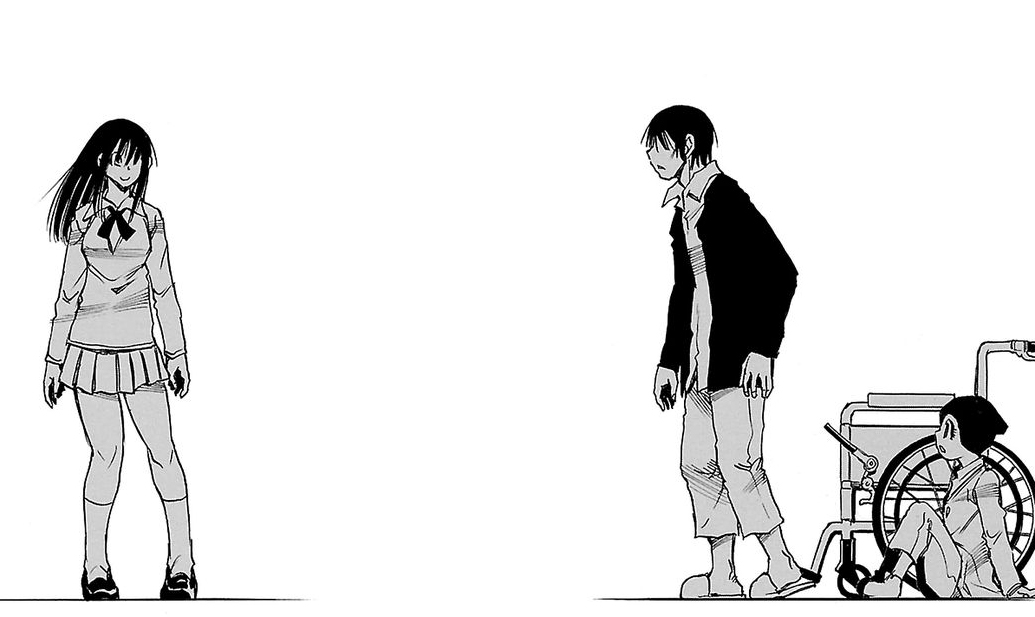
This could've been such a powerful scene...
Personally, I liked Airi more than Kayo. But it was the director's decision to cut her parts to a bare minimum... oh well (sadpanda).
#3: The anime had to be created while the manga wasn't finished yet
This may seem strange since the manga ended around the period the first few episodes started airing, and the crew would've had the time to sit together with the mangaka to adapt the ending.
But again, the director also had to be busy with the SAO movie and only had 12 episodes to tell this story. So the crew decided to cut just about the last 8-10 chapters and create the last episode of their own, trying to come to a similar conclusion to the manga. Truth be told, the screenwriter's only option in this fashion was failing. The anime ending thus became... average (to say it nicely).
And while the ending of the manga wasn't hot shit either (the story sure ain't no Steins;Gate); it was at least way more enjoyable than what we ended up getting here.

Not the best finale, but still more enjoyable than the anime
#4: The removal of Yashiro's bakstory makes the villain's motives weak in the anime
Yes, there is no excuse for this one. While certain elements are never really explained (like why the superpowers and why they disappear), the backstory of Yashiro fixes a whole slew of issues people have with this anime.
In short: Yashiro was forced to help his brother rape schoolgirls. But when his brother stepped out of bounds and killed one of those girls, Yashiro's powers kicked in and he started seeing Spider Threads he could cut (which seems taken from Greek mythology, but is actually based on a famous Japanese folktale). Yashiro ended up killing his own brother and was able to successfully frame it as a suicide.

#5: The superpowers never really get explained, do they?
They come from somewhere. In Yashiro's case, he sees the story he read come to life; in Satoru's case it's an expansion of both his desire to become a superhero and his enormous regret of not being able to save Hiromi (not Kayo btw) in the past.
But that's about all we get as an explanation. I get that we don't need everything spelled out. But considering Satoru's powers disappear during the series, you'd at least expect some form of explanation. We don't get that. Also, the story doesn't really experiment too much with said powers.
Well, at least we know that awkwardly screaming at the top of your lungs helps activate it [/sarcasm].
So why do I still like it?
The direction used, the general look and feel, certain specific moment and yes: even the symbolism that the series uses. The general story and drama in this story lured me in, even if I knew that many people hated on the story. I still liked it. Heck, I didn't even mind all the symbolism used in the show (the infamous red=bad; blue=good color schemes, the perversion of justice, the regret symbolism, the Hero symbolism, and other things).
I like it, because several good moments stick, even after the anime has ended.
In my first part, I already talked about how I loved the Christmas tree scene, which I still love.But there are a few more, which I still fondly remember.
One big scene that I want to talk about is Satoru's contemplation of killing Kayo's mother. While it doesn't make sense time-wise and the taser got removed in the transition from manga to anime (yeah, he had a taser, look it up!), everything about it seemed to work. His rage, the buildup and even the eventual intervention of Kenya. All in all, the scene takes less than a minute. But I couldn't help thinking in myself "Do it!"

The other big scene I love is Kayo's first home-cooked breakfast meal moment. This got put on the most heartwarming moments of the year list of Crunchyroll's anime awards and only lost due to YOI-hype. It is very captivating.
There's obviously even more great moments, but I'll leave that for you to figure out.
I like it because in the end it's a story about a man who tries to save his own mother

Yes, I may be biased on this, since I'm a man who has a close bond with his mother and I have no idea what I'd do if I found my mother murdered in cold blood.
I can't help to feel emotional the moment that Satoru once again meets with his mom and finds out she's still alive in this timeline.
But on the other end, who can blame Satoru? Satoru's mom is one of the best supporting characters I've seen in 2016 and is probably the best mom in anime in general.
I like it because it's a good drama, not a mystery anime and hardly a thriller
A lot of people that hated this anime, hated it because it's not a good mystery nor a good thriller.
And I (kind of) agree with that. The mystery never really went anywhere. There weren't enough (good) red herrings to send the audience the wrong way. But it never was intended as a mystery story. It somehow got presented that way, and that may have been very wrong on the anime's side of things.
Because in the end, this is a Drama with supernatural elements and a hint of a thriller and mystery. This is the story about Saturo being given a chance to remove his feelings of regret. To save his mother, to save his murdered childhood "friends", to save himself from his "broken" personality... to become the hero he always wanted to be.

I like this anime, because it is a critical piece against Japan's justice system
A lot of people critique certain decisions people make or have made in the anime. Why did Satoru ran away from the crime scene in the first episode? Why are both Airi and Kenya so focused on helping Satoru? It all connects to the same thing. The author's personal critique against Japan's way of handling Justice.
Have you ever played an Ace Attorney game? If you have, you might've thought by yourself that the court works in a bizarre way in these games. Well... THAT is basically Japan's Justice system (safe the "everything needs to be decided in three days" part). The prosecutor and police work together to find an accused party, find evidence and consider him/her guilty. Then it's up to the defense attorney to prove the court otherwise.
In short... You're guilty until you're proven guilty... unless the defense can get you to be declared innocent.

This way of thinking is opposite to the Western standards, where people are innocent until the prosecutor and police have sufficient evidence to prove you're guilty.
While our Western system isn't 100% good either, I'd rather prefer to be judged over here. I don't think I have to tell you that the Japanese justice system and the general way of thinking is the root cause of many family drama's and many people end up being opposed to it. This includes the mangaka Kei Sanbe.
The theme of justice is a frequently recurring element in the story of Erased. I could go in even more detail on what elements represent this, but I'll leave the video of Pause & Select here instead, who explains the "perversion of Justice" in Japan and in Erased (which is where previous image comes from). Go watch it!
Anything else?
I think I could go on for ages, since there's so much to talk about. I didn't even cover things like the child abuse, nor the "kids don't act their age" remark many people had. But I erased those parts since I felt I couldn't make a convincing argument from either side. There's people that say those things are handled well, while others say it's handled poorly. I noticed I'm somewhere in the middle on those things.
Other than that, I'm finally glad I was able to finish this in a way I'm somewhat satisfied with it. Monday it's time for regular reviews again. Got a few lined up.
Until then, V out.


